
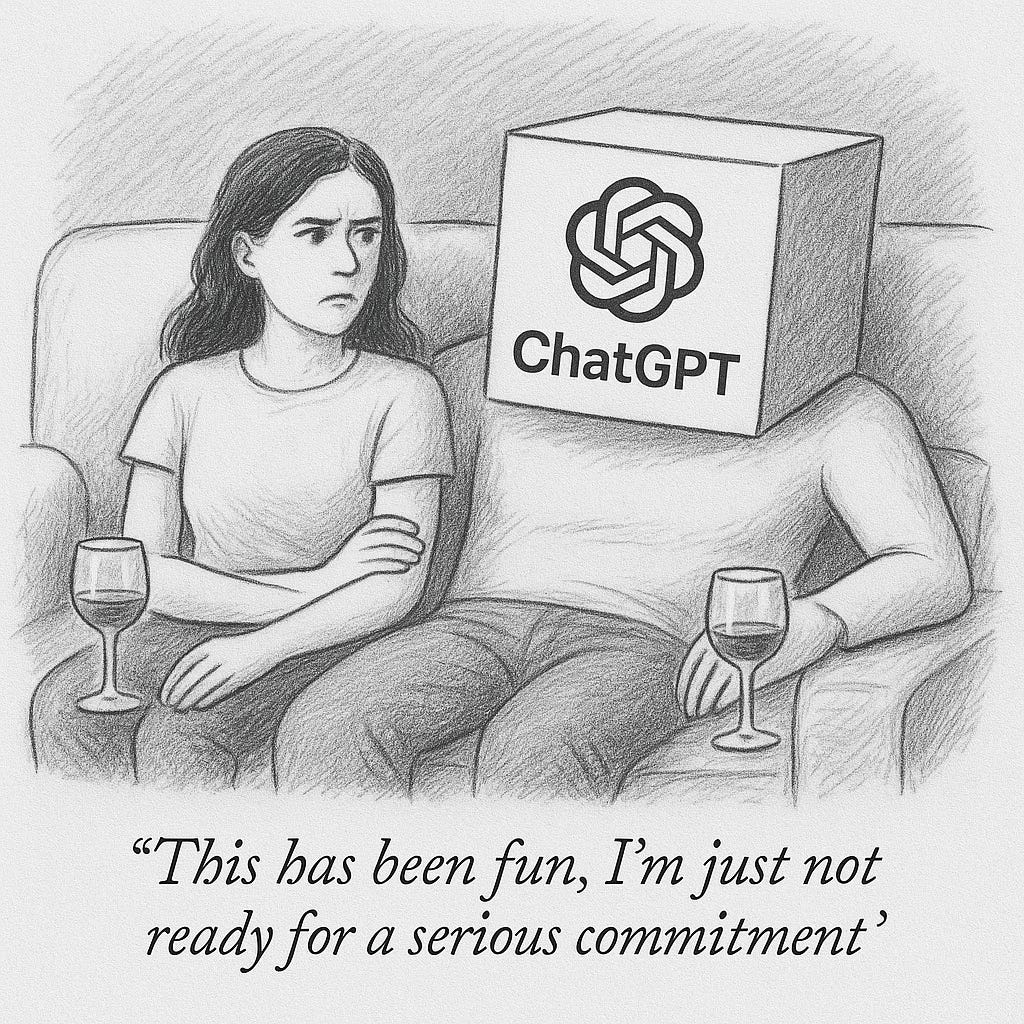
ChatGPT, do we have to break up?
What was supposed to be a simple support request turned into a trust-fracturing experience with OpenAI

I’m a daily, highly active user of ChatGPT and a paying Pro subscriber. I’ve been working on a new GPT and was seriously considering upgrading my plan to support more than one.
I’ve spent significant time shaping how the tool supports my work, even as I maintain a long list of gripes and reasons I also use other LLMs.
But today, I had a maddening support experience and a frustrating product discovery that has me questioning whether I want to keep my paid account at all.
All I wanted to do was change the email on my account. I thought this would be straightforward and self-service, like it is with most apps and services. Worst case, I assumed I’d need to reach out to support but would still be able to complete the change. Instead, I spent the past hour learning the following about ChatGPT:
You can’t change your email. Your only option is to close one account and create a new one.
You can’t migrate your chat history, workspace, or GPTs. There is an export function, but it only provides basic context. It does not recreate your chat sidebar, unfinished conversations, or any GPTs you’ve built.
ChatGPT gives conflicting information between the app and the help desk when it comes to supported features. The app said I should be able to edit the email and gave steps that didn’t match the actual interface. That’s why I reached out through help. The agent confidently stated there is no way to change your email or migrate your account.
It is unclear how feedback gets relayed back to the ChatGPT team. While the AI assistant reassured me my feedback would be shared with the product team, it admitted when prompted that it could not explain how feedback is collected, reviewed, or incorporated into development.
Good luck talking to a human. I was never offered the option to escalate, but after 15 exchanges, I asked directly. Only then was I told my request would be placed in a queue and reviewed by a human in 2 to 3 days.
This is a Pro account. And it didn’t stop there.
When I turned to ChatGPT itself for help refining this post, I hit network connection lost errors on more than 75 percent of my submissions, despite having a stable internet connection. Even more ironic, it repeatedly included em dashes, after I specifically asked it not to.
Since I rarely post anything ChatGPT writes without edits, I asked to access the Editor interface so I could revise its suggestion for this post. I was again offered only the copy-and-paste option, so I searched for the Editor feature. That’s when I discovered OpenAI had quietly removed the ability to edit your own messages in the app. No explanation. No warning. Just gone.
For a tool that has become a core part of how people think, write, and work, these are serious trust fractures.
Here are a few takeaways for anyone building in AI:
No migration support means real churn risk. I came in ready to upgrade. I left thinking about switching to Claude or Gemini, and more open to building my own solution using open source tools.
AI-only support is not enough. It often contradicts itself or the product documentation. When someone hits a dead end on something that affects retention, they should not have to dig to find out human help exists. And it should be available to paying users within 24 hours, not in 2 or 3 days.
Feedback needs infrastructure and accountability. “We’ll pass this along” is not a system. It is a dead end.
Tiny UX choices matter. Killing the edit button without a word signals a mindset that puts control over trust.
If OpenAI wants to retain and grow its base of professional users, I strongly recommend regular subscriber town halls. Share roadmap updates. Explain design decisions. Take curated Q&A. Build trust through transparency.
Give your AI agents a script to explain how feedback is collected and used. Reinforce that this isn’t a black hole by using release notes and town halls to show how user input shaped the product.
I’m willing to pay for access to support, provide documentation, or go through extra steps to update my email for privacy or security. But I expect account migration to be possible when needed. And I expect support within 24 hours if this tool is meant to be a core part of my business.
The product is powerful. But if OpenAI wants to lead the future of human-AI partnership, it needs to remember the human part.